Brief historical background on the use of coal.
Mankind has long used coal as fuel. There are evidences of early use of coal in different parts of the world. The use of coal in China can be traced back to the 2nd century B.C., the time of the Han Dynasty or even to earlier periods, according to some historians. More important is that in the 12th century during the Song dynasty, six centuries before the industrial revolution in England the Chinese began to use coal for the production of cast iron on an industrial scale. In Greece, the information on use of coal by blacksmiths dates 4th century B.C. Britain's coal mines were developed by the Romans up to the 2nd century and coal cinders were found in the ruins dating back to the 4th century.
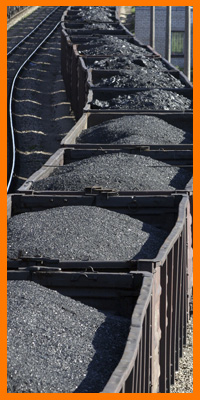
Coal consumption grew exponentially during the industrial revolution of the 18th and 19th centuries. Two elements, the steam engine and the cast iron production, have affected each other and triggered rapid growth of coal consumption. In 1712 in England, the Atmospheric Steam Engine was invented by Thomas Newcomen to pump out water, which was later greatly improved by James Watt in 1765. Watt Steam Engine was originally used for pumping water, but then found its use in the textile production. The first Steamboat was invented by Robert Fulton and in 1807, and in the United States the first voyage of the steam ship had happened. Meanwhile, in 1814 in England, George Stephenson built the locomotive, and in 1825 the first public steam railway began its operation. Such industrial achievements were made possible by the new technology of steel production, in which the charcoal was replaced by coking coal in cast iron smelting. This was first applied in 1690-ies during lead and copper sweetening and then at iron foundries. In turn, steel production in large amounts contributed to the boilers, steam engines, and railroads manufacturing.
Coal was also used for gas lighting. To do this, first you had to gasify coal in furnaces. The resulting gas was placed in storages and distributed (come on the market). The first gas street lamps were used in London in the beginning of the 19th century. In 1882 in New York, the first coal-fired power plant created by Thomas Edison began its operation, generating electricity for household light bulbs.
In the middle of the 18th century in Britain approximately 3.000 coal mines were operating and the country has 60% of the world coal production. By the beginning of the 20 century United States surpassed Britain in terms of coal mining volumes. By the beginning of the 1920’s, the country consumed about 50% of the coal mined in the world – like China at the beginning of the 21st century.
Before the beginning of the First World War, W. Churchill switched the British Navy from coal to oil fuel. This fact is considered by many as the beginning of a change of main source of energy for mankind, from coal to oil. In 1960’s, the oil has surpassed coal as an essential energy source, which has contributed to the rapid growth of the total energy consumption during that decade and further.
Coal has made a historic contribution to the creation of the European Union. In 1951, Belgium, France, Luxembourg, Netherlands, and West Germany signed the Paris agreement on establishing the common market for coal and steel.
10 FACTS ABOUT COAL
1) Coal is the remains of plants died many millions of years ago, rotting of which was interrupted as a result of the cessation of air flow. Therefore, they were unable to give gathered carbon back to the atmosphere. Air flow was drastically terminated in places where swamps and marshy forests descend as a result of the tectonic shifts and changes in climatic conditions and were covered with other substances from above. During this, plant remains while exposed to bacteria and fungi turned (coalificated) into the turf, and then into brown coal, hard coal, anthracite, and graphite.
2)
Age the oldest coal is estimated to be around 300-400 million years.
3)
.) Under the pressure of sediments section with a volume of 1 kilometer, a layer of brown coal with thickness of 4 meters is produced from a 20-meter turf layer. If the formation depth of plant material reaches 3 km, then the same layer of turf will be turned into the hard coal layer with thickness of 2 meters. At greater depth, approximately 6 kilometers, and at a higher temperature 20-meter layer of turf becomes a layer of anthracite with thickness of 1.5 meter.
4)
Coal became the first type of fossil fuel used by humans.
5)
According to the BP Statistics, R/P reserves to production ratio (the ratio of remaining reserves against the annual extraction) for coal currently stands at 122 years. For comparison: reserves to production ratio for oil is 42 years, for natural gas - 60 years.
6)
Half of all electricity on Earth is produced from coal.
7)
The largest of proven coal reserves belong to the United States, followed by Russia and China. These three countries have the 60% of the world's proven reserves of coal.
8)
Steam boilers, powering up the Titanic, have consumed 825 tons of coal per day.
9)
Canaries are very sensitive to the amount of methane in the air. This feature was one time used by miners who, while descending under the Earth, were taking along a cage with a canary. If the singing was not heard for a long time, it meant that it is time to get out of the mine quickly.
10)
Only in 2004, the fire at the Chinese coal mine Liuhuanggou was extinguished, lasting continuously for 130 years. Flame burned almost 2 million tons of coal per year.

